Catching Up On A Tuesday Evening And Looking Ahead…

January is flying by! With only 10 days left in the month, Indianapolis is running a whopping 8.2° above normal along with more than 3″ above normal in the precipitation department (unfortunately for snow lovers, this excess moisture has fallen primarily as rain, as IND is running a deficit of 5.2″ in the snowfall department).

January month-to-date temperature anomalies, courtesy of the Midwestern Regional Climate Center
January month-to-date precipitation anomalies, courtesy of the Midwestern Regional Climate Center

On a broader scale, here’s a look at the current month-to-date temperature anomalies for the Lower 48 as a whole:

January Lower 48 month-to-date ‘mean’ temperature anomalies, courtesy of weathermodels.com

As a refresher, our January forecast looked like this:

The baseline of this thinking had to do with the idea we had that the MJO would roll out of the warm phases (5 and 6) and strongly into the colder phases after mid-month. Secondly, the other driver was the thought that the current SST configuration in the north Pacific would “force” a negative EPO as the winter season matured.

While the MJO did, indeed, rumble out of the warmer phases just after mid-month, the EPO has not cooperated. Furthermore, instead of the MJO tracking into Phases 8, 1, and 2, it appears it wants to go into the “null” phase to figure out its ultimate destination for the 2nd half of winter (this will be key with Feb. and March). While this doesn’t necessarily support warmth, it doesn’t offer enough ammo to fight the warm signal from the strongly positive EPO.

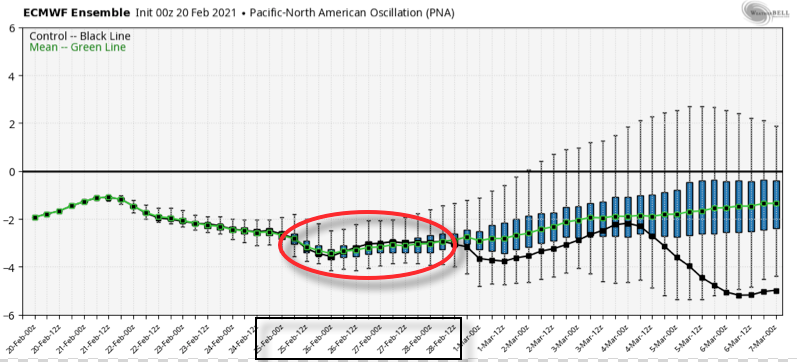
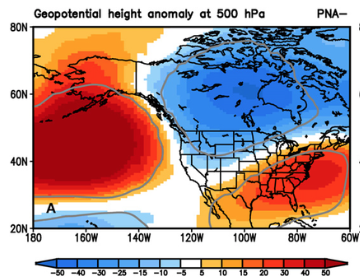
Now that we’re beginning to turn the page to the 2nd half of winter, there are other items to begin paying closer attention to. In addition to the EPO and MJO, some of these features include the AO, NAO, and PNA. With that said, to drive more of a consistent colder than normal theme, we need to get the EPO at least into the neutral range as some of the other ingredients noted above transition into more favorable colder phases. With a strongly positive EPO, it’ll be tough to sustain well below average temperatures.

With all of that said, all hope is not lost for winter lovers. Climatology speaking, we’re in the coldest time of the year. Even in “marginally” cold patterns, or even “warm” patterns this time of year, wintry issues can create headaches. Secondly, it’s worth paying close attention to the MJO over the next couple of weeks as some of the data wants to take things out of the null phase and transition towards the traditionally colder phases of 8, 1, 2, and 3.

As it is, the next couple of weeks should present a fairly active storm track across the region. In the face of what should truly be a “torch” pattern, the saving grace (at least for fans of winter weather) has to do with the strong Hudson Bay ridge and tendency this kind of pattern has to force stormy times underneath. While far from a “slam dunk,” these kind of patterns can produce- even in the face of a strong positive EPO.

If you had to choose, would you rather have a bitterly cold and dry regime or seasonably mild with at least being on the playing field for wintry mischief over the next couple of weeks?

More in the AM, friends. Make it a relaxing evening! 🙂

Tuesday Morning Rambles: Weak Midweek System Followed By Another Strong Late Week Storm…

1.) Patchy fog will burn off to another day with mostly cloudy conditions (should see a bit more sunshine than we saw on Monday) and mild temperatures. Mid 30s will warm into the lower 50s today and middle 50s Wednesday. The downside to Wednesday’s mild air? Light rain will scoot across the state. “Light” is the key word with amounts of a trace to under 0.10″.

Light rain will move across Indiana Wednesday.
Rainfall amounts of only 0.05″ to 0.10″ can be expected Wednesday.

2.) A cold front will push south across the region Wednesday evening and result in colder conditions (but with increased sunshine) Thursday. Highs in the lower to middle 30s can be expected across central Indiana Thursday.

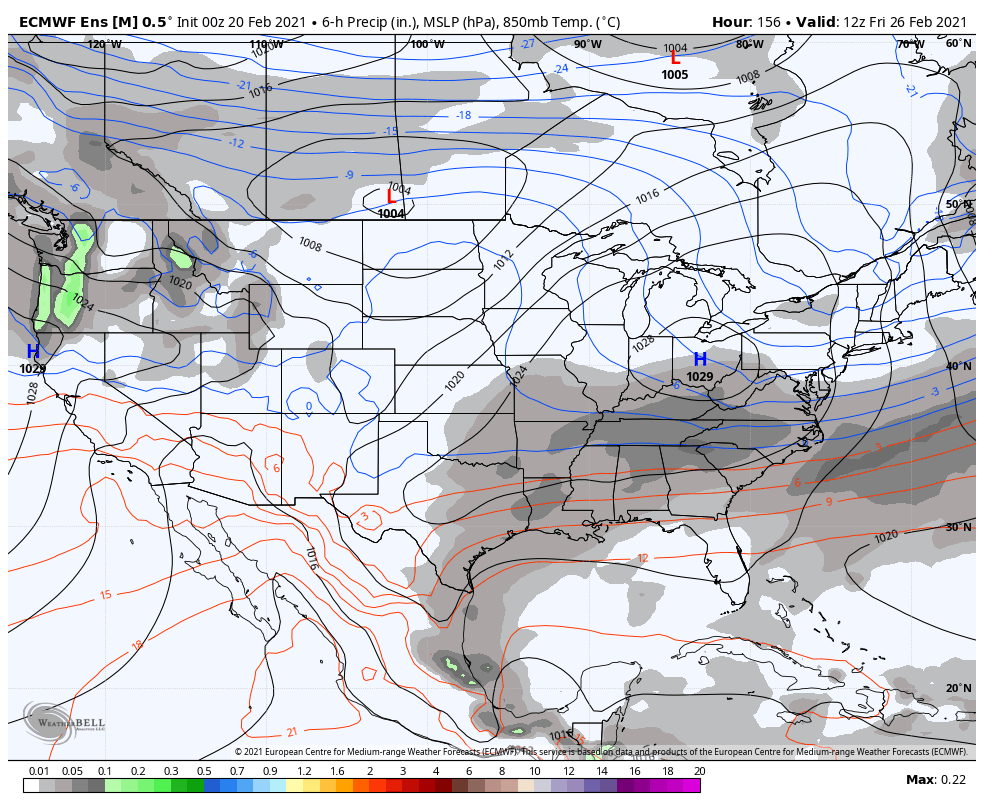
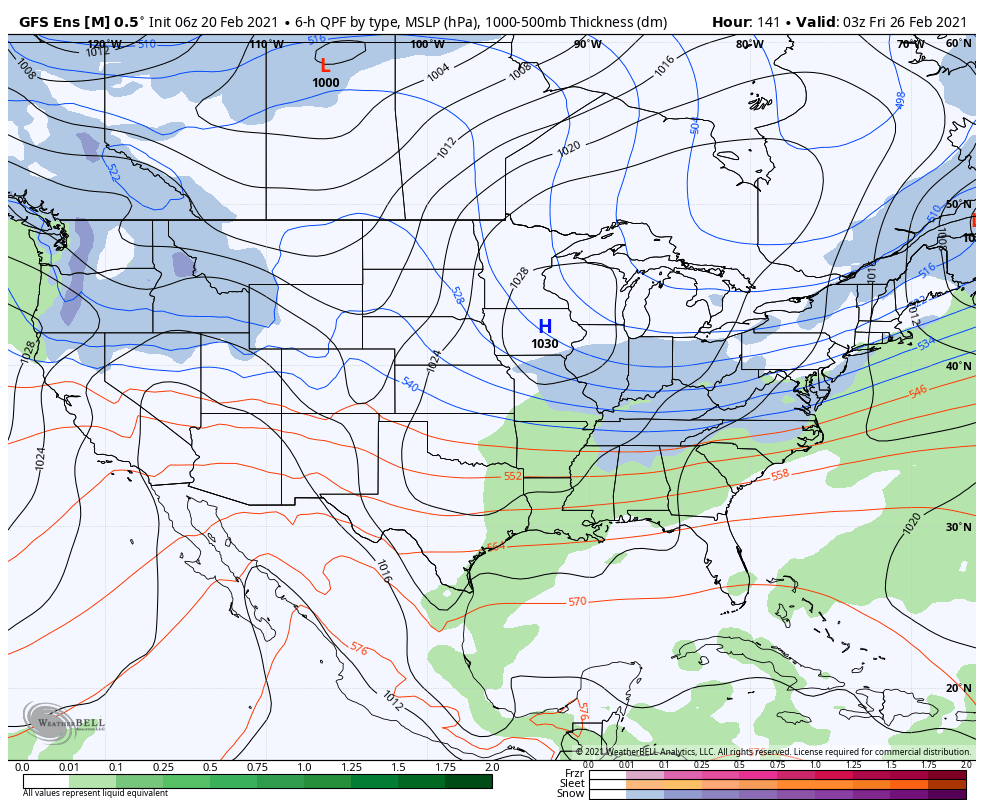
3.) As we move into late week, a stronger storm system will impact the area. Low pressure will develop along the lee of the Rockies Friday morning before tracking into the lower Great Lakes Saturday morning and into New England Sunday. With marginally cold air in place Friday (courtesy of Wednesday evening’s cold front), “overrunning” precipitation should fall as a wintry mix of snow and sleet Friday afternoon. While still early, it’s possible a quick couple inches of snow and sleet make travel messy Friday PM (worth keeping a close eye on) before precipitation changes to a cold rain Friday night into the predawn Saturday. Eventually, as the cold front whips across the state, colder air will return Saturday morning and precipitation will end as snow showers.

Snow and a wintry mix, including sleet will move into central Indiana Friday afternoon.

4.) The previously mentioned storm system will usher more of a prolonged wintry pattern back into the eastern portion of the country. As we look ahead through the remainder of the month, below normal temperatures are expected to carry the day, along with the threat of additional wintry precipitation from time to time. This is the kind of pattern that will certainly promote storms and “rumors of storms” and it’ll be important to remain locked into the forecast as we put a close on January.

Dinnertime Rambles: Stage Set For The Next Couple Weeks…

The storm system that will impact the region late this week will really be a precursor of what lies ahead over the upcoming 10-14 days.

Here’s how we envision the ‘mean’ pattern shaping up through the January 20th time period:

This pattern is driven by Phase 5 of the Madden Julian Oscillation (MJO) and, secondarily, by a positive EPO.

Upper air patterns in January typically look like this during MJO Phase 5:

The analog composite above isn’t as strong compared to reality with the northern Plains/ Rockies cold and that’s where things could potentially turn a bit more interesting, locally, once out of Phase 5 (more on this a bit later in the week). As it is, this cold will try to press and as this takes place, resistance from the East Coast ridge will put up a fight. The battle ground will set-up over our neck of the woods and the end result will be an active/ stormy pattern that features “transitional” cold shots. This time of year, even warmest of patterns can present wintry challenges, however. Case in point is this weekend. Personally, I think what will actually take place with respect to the strength and track of the low pressure system will end up being a blend of the intense European and more progressive GFS. It’s going to be mighty tough to drive such an intense low so far northwest, per the Euro- especially considering the placement/ strength of the high to the north.

With that said, this continues to place northern parts of the state under the threat of a wintry mix of snow and freezing rain/ sleet, while central and southern areas deal with flooding rain. If traveling the state Saturday, expect a significant temperature gradient that will result in a difference of as much as 20° within 10 miles in some cases, especially across north-central parts of the state. I think there’s still the chance rain could end as wet snow across central Indiana Saturday PM, but the better chances of accumulating wintry precipitation will likely be to our north.

Locally, the bigger concern at this point has to do with the potential of 2.5″ to 3.5″ of rain with locally heavier amounts. The bulk of this likely falls late Friday night into Saturday morning. Localized flooding is possible and we’ll likely have to begin issuing storm briefs this time tomorrow.

Next up will come storm threats in the 1/14 and 1/16-1/17 time frame…

Stay tuned, friends.

Fresh Short-Term Update; Longer Range Rambles…

Dry air continues to “eat away” at the advancement of precipitation northward this afternoon. It now appears as if we’ll escape rain-free through the evening hours, with steadier rain lifting north into central Indiana towards 10p to 11p.

Heaviest totals still look like they’ll fall across southeastern Indiana (amounts up to 1″ possible) with lighter amounts of .20″ to .40″ across the more immediate area.

Most of the daytime Friday will feature a lack of significant rain, but there could be some drizzle and spotty light shower activity around at times.

It’s as we get into Saturday morning that we need to monitor the track of vigorous upper level energy moving southeast out of the northern Plains and into the lower Ohio Valley. In response to this, an expanding area of snow and/ or mixed precipitation should initially develop across Iowa before building into Indiana prior to sunrise. These systems are admittedly tricky and can spawn surprises and we’ll keep close eyes on things over the next 24-36 hours. As things stand now, I would place the best chances of accumulating snow from Iowa, northern IL, northern IN, and into northern OH with this system, but please stay tuned.

The next weather maker, locally, will likely be responsible for another opportunity of snow Tuesday into Wednesday.

In a way it’s ironic we’re looking at back-to-back opportunities of sticking snow in what’s a warmer than average pattern. This, of course, is on the heels of December’s above average snowfall month. Central Indiana snowlovers know all too well that frigid patterns can be bone dry around these parts…

Longer range hinges squarely on the shoulders of the MJO. Things are highly amplified and will result in one of two scenarios- swinging out of the warm phases and into the traditionally cold phases for mid-winter after mid-month, or circle back through Phase 5. If it’s the latter, anomalous warmth would continue across the east while significant cold takes up shop across the west. In January, Phase 5 is the last thing eastern fans of winter want to see.

As it is, I continue to believe the favorable northeast Pacific will have the final say on this winter with a more favorable regime developing during the 2nd half of January that would pull the cold into the region in more sustained fashion (next 10-14 days will feature transitional cold along with the stormy pattern).

The latest European Weeklies may be starting to see this as the relative warmth in Week 2 gives way to colder times Week 3.

MJO Phase 5 is set to dominate the Week 2 timeframe.
New Weeks 3-4 shows a colder pattern developing.

A very active pattern is set to remain intact over the next 2-3 weeks and even in the warm patterns, snow and wintry mix events can prove to be a headache this time of year.

Both the GEFS and EPS show the EPO moving from a strongly positive phase now (also argues for the warmer than overall pattern in the immediate-medium term) towards neutral to negative after mid-month. We’ve been noticing the tendency both models have had trying to drive the negative EPO too quickly (recall only a few days ago the models wanted to develop the negative EPO around the 12th or 13th).

Rest assured, our eyes will be glued to the MJO and EPO through the 2nd half of the month. Time will tell if the highly anticipated favorable warm northeast Pacific SSTs will begin to do the trick…

Important To Know What Lever To Pull And When…

As another year comes to a close and the winter pattern begins to “mature,” we thought we’d do a little rambling…

This evening’s rambles have to do with the variety of “drivers” that at times like to take control of our weather pattern. You hear us use terms like the MJO, EPO, AO, PNA, and NAO (amongst others) often, but at times, these various pattern drivers can have more impact than others, and at varied times of the year.

Traditionally, if the MJO (Madden Julian Oscillation) is highly amplified, that’s going to serve as the basis of our medium or longer range forecasts. However, if the MJO is in the null phase, other teleconnections can take control of the wheel. Sea-surface temperature configuration can give hints to the way these elements may behave during the season(s) ahead, but we caution each respective season takes on a flavor unique to it’s own. That’s what makes this business so fun, challenging, and, at times, frustrating. 🙂

It’s also important to understand when the ingredients noted above have the greatest impact on our immediate weather. We love to lean more heavily towards the NAO and AO mid-to-late winter into the spring, for instance. Case in point, a negative EPO and positive PNA can quickly trump a positive AO/ NAO this time of year, and vice-versa.

In the event you didn’t have a chance to see it Sunday, we released our January Outlook. We have a very stormy month outlined that includes cold “overwhelming” things as the month progresses. A lot of this has to do with the fact we think we see a “shake-up” with the MJO out of the warm phases and into the traditional cold phases of 8,1, and 2 taking shape during the 2nd half of the month. Additionally, we continue to believe the favorable north Pacific sea surface temperature configuration (for a cold Great Lakes and OHV) will begin to force the negative EPO/ positive PNA.

The NEW European Weeklies show the transitional time of things through the 1st half of the month, but note the building more persistent NW NA ridge during the 2nd half of the month and corresponding reflection of an eastern trough. Should the MJO be heading into Phase 8 around this time frame (and we think it will), this trough will likely correct stronger in future updates for late month.

The model sees the stormy time of things through the month and into February. (Important to note that even “warm” months this time of year can also feature above normal snow. Just see this December- nearly an inch above normal for the month). As things stand now, we see multiple opportunities for snow as January gets underway, including Saturday PM, and again Tuesday night into Wednesday.

Make it a great evening! We’ll be back early in the morning with a fresh video update.