Long Range Update: Pattern Evolution Through February…
Updated 01.28.22 @ 7:32a
You must be logged in to view this content. Click Here to become a member of IndyWX.com for full access. Already a member of IndyWx.com All-Access? Log-in here.
Updated 01.28.22 @ 7:32a
You must be logged in to view this content. Click Here to become a member of IndyWX.com for full access. Already a member of IndyWx.com All-Access? Log-in here.
Updated 01.14.22 @ 7a
The primary driver (the Madden Julian Oscillation, or MJO) will be in a favorable phase to allow colder than average temperatures to take up residence across the eastern part of the country as we close out January. To no surprise, these particular phases favor positive heights over the high latitudes (blocking) which helps drive more of a persistent colder than normal pattern.
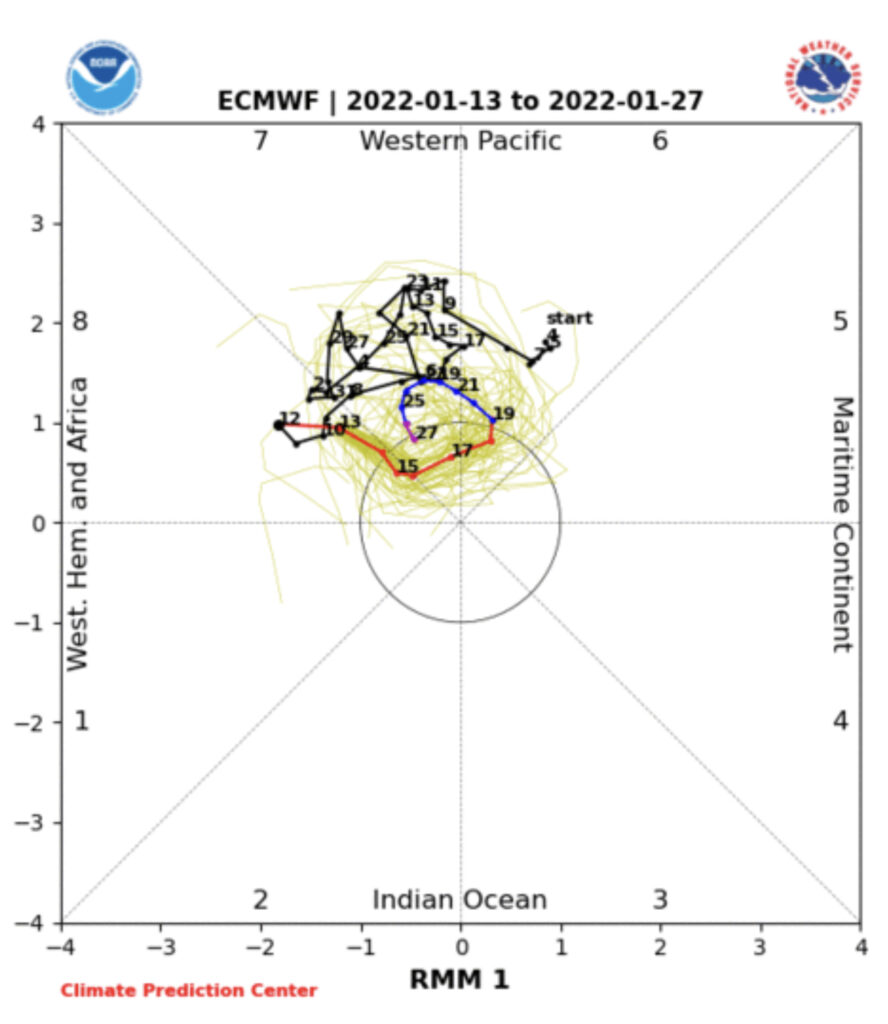
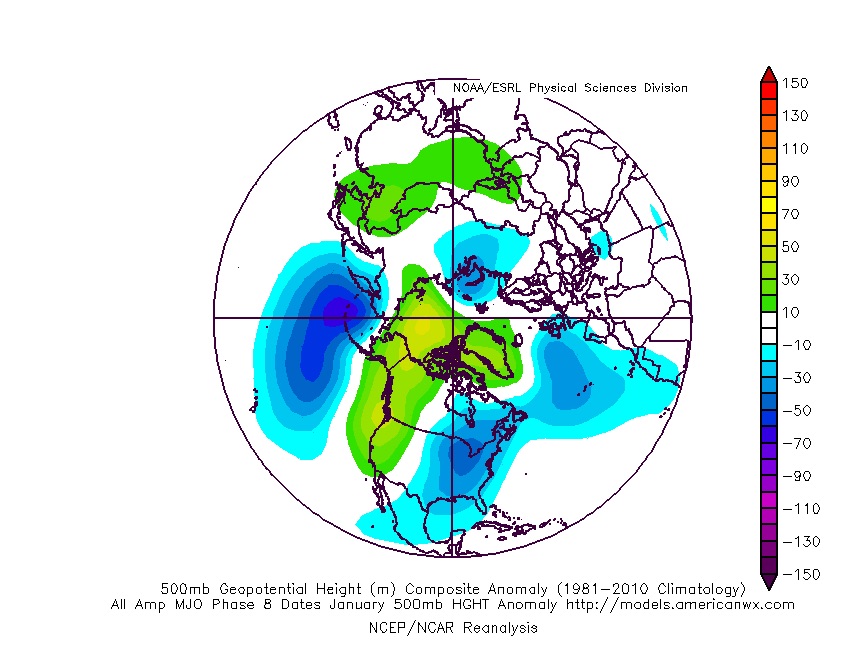
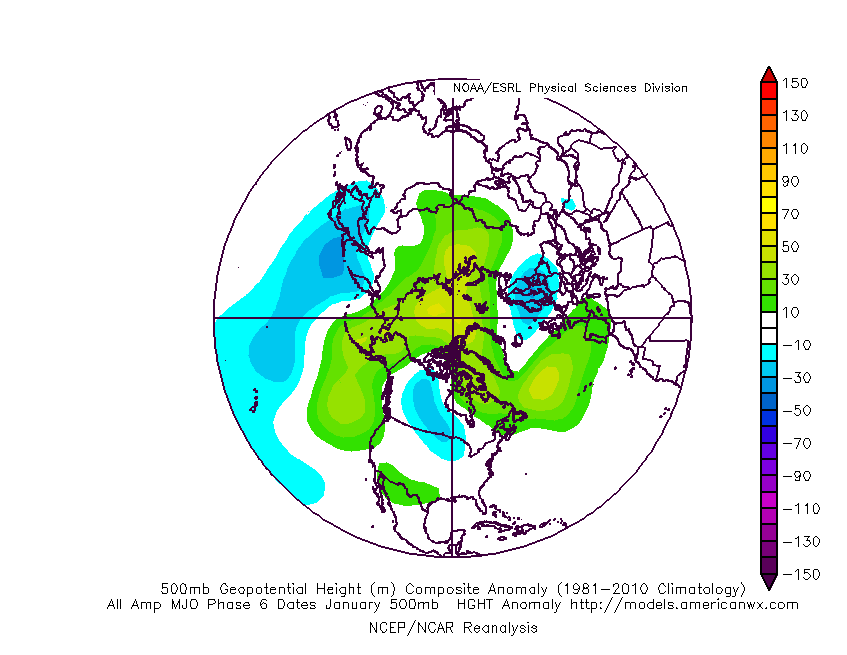

We’ll keep an eye if the MJO gets stuck in the neutral phase, but the “loop” around into Phase 6 this time of year would continue to favor cooler (to colder) than normal conditions across our portion of the country.
That brings us to our teleconnections. The “big 3” (this time of year include the AO, EPO, and PNA) are also all in favorable position to deliver a colder than normal pattern to close January.

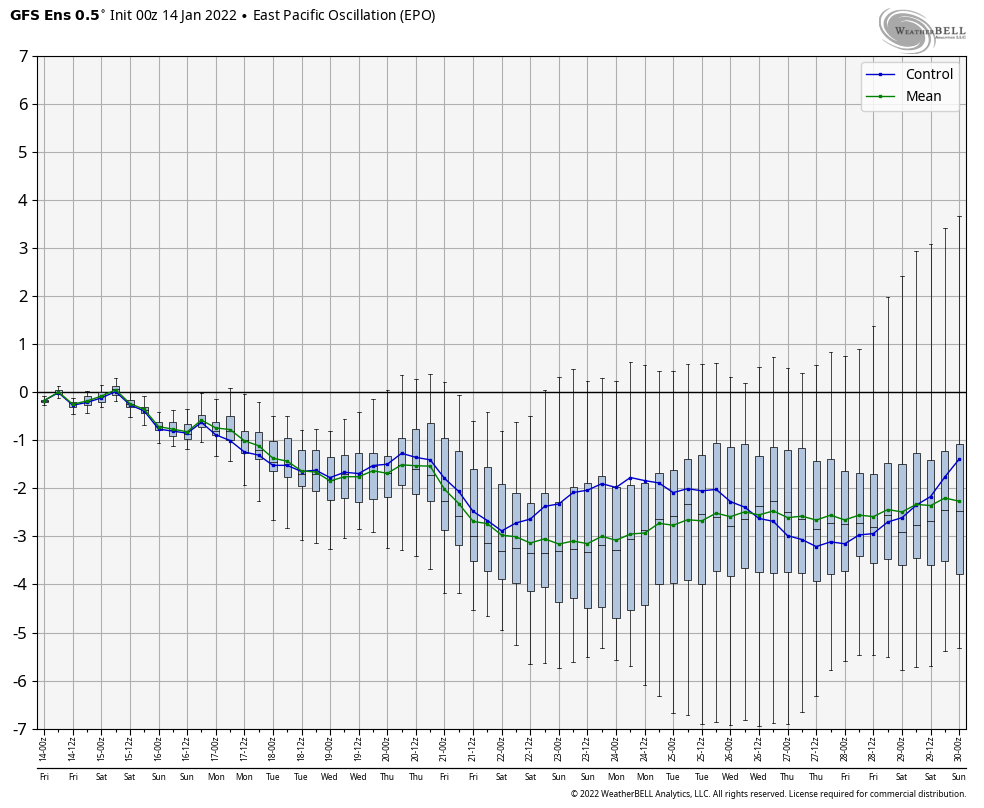

One could also build a case that February would at least open colder than normal based off a combo of the above (MJO and teleconnections) and we agree with that idea, but do believe a “flip” in the regime is ahead after the first week, or so, of the month to milder times.
To no surprise, modeling is showing this cold close to the month.
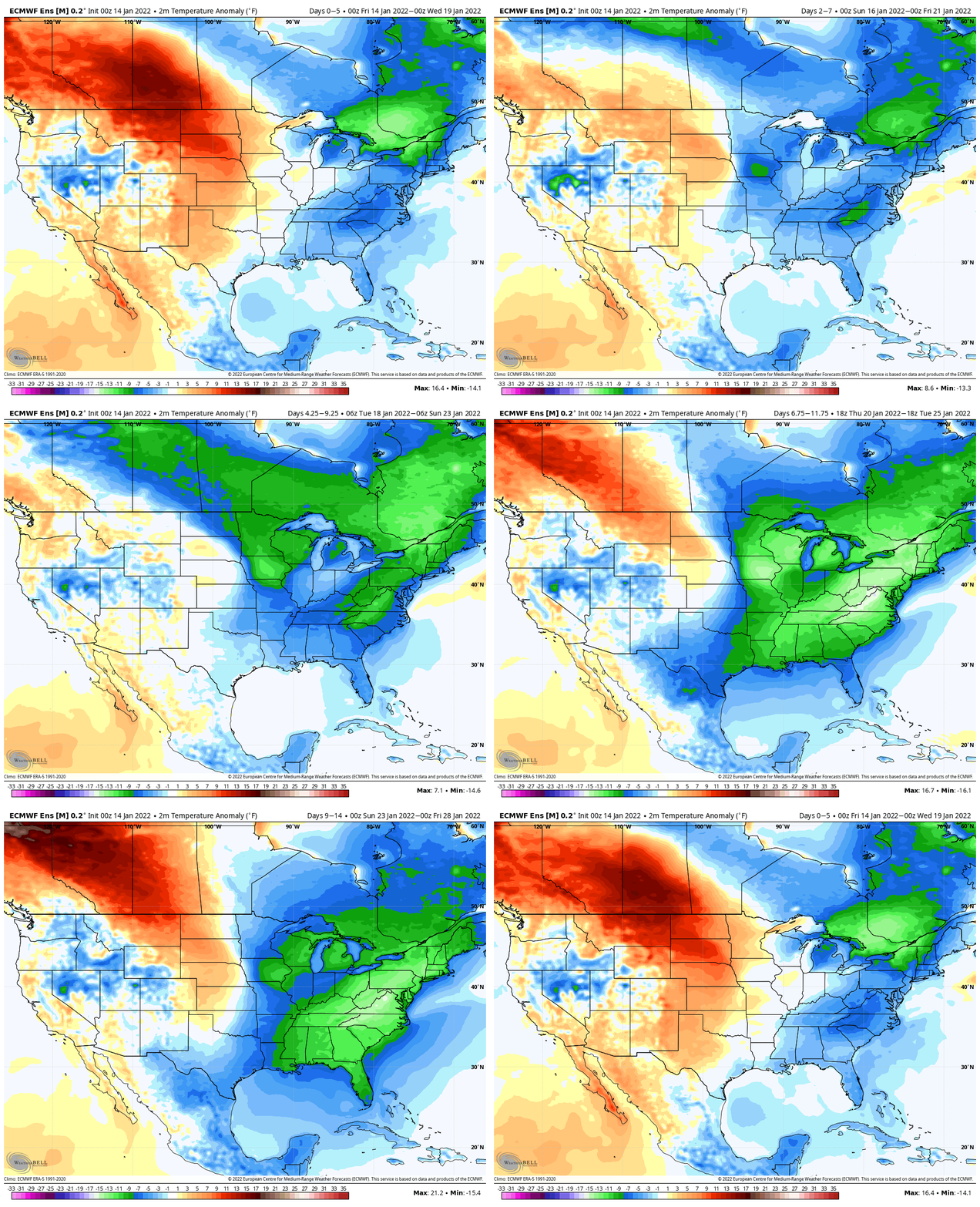
The opportunity is present for Week 2 to be bitterly cold, as the European is hinting above. Sub-zero temperatures are on the table, especially if we can get some snow down.
Speaking of snow, this pattern should produce a couple opportunities for central Indiana to get in on the act before the end of the month, or beginning of February. Despite the incredibly slow start to the season, take any one particular solution with a grain of salt when looking at operational guidance 2 weeks out.
Updated 01.12.22 @ 7:23a
You must be logged in to view this content. Click Here to become a member of IndyWX.com for full access. Already a member of IndyWx.com All-Access? Log-in here.
Updated 01.08.22 @ 4:35p
While we’re dealing with our own wintry precipitation this afternoon, snow lovers continue to wait for the first big event of the season. Watching 2 snow storms blow by to our south over the past week was an added sting.
Patience may very well be rewarded as we navigate the second half of the month as a classic wintry pattern carves itself out over the eastern portion of the country.
The GFS was first to key in on this pattern evolution, and now, today, the European is finally seeing the light (shown below). What makes this pattern different is the likelihood of high latitude blocking (courtesy of a negative arctic oscillation) which will help the regime sustain itself. On that note, it’s been my experience that the GFS does better handling AO transitions from positive to negative and was the primary reason we leaned on the GEFS earlier this week. Run to run consistency was also another player.

November and December failed to produce teleconnections that were aligned for cold, but that should change as we push towards mid month. This is ultimately a byproduct of the primary driver- the MJO rumbling into Phase 8 (finally). As the AO goes negative, the EPO should follow suit. Unlike in December, the PNA should also be in a much more favorable state for persistent eastern cold.
The idea here is that the majority (if not all) of the second half of January will feature below to well below average temperatures and multiple opportunities for “more meaningful” snow- whether it be from a series of Clippers, a more classic panhandle cross-country winter storm (example pictured below), or a combination of both.

At the very least, it’s certainly not a boring pattern, and for the first time this season, it appears as if we’ll be able to lock this cold in.

Updated 01.06.22 @ 7:20a
You must be logged in to view this content. Click Here to become a member of IndyWX.com for full access. Already a member of IndyWx.com All-Access? Log-in here.