Category: European Model

A Lot Of Weather To Talk About…

Mother Nature seems determined to put us weather forecasters to hard work as we get set to head into the Christmas season and welcome in 2014.  We’re tracking a major flood situation that will unfold across central Indiana over the upcoming weekend, followed by a reload of the cold and potentially a storm with a more wintry component as we get closer to the New Year.

First things first and that’s the significant flood threat in the short-term period.  Without trying to go into scare tactic mode, current model data would result in a downright dangerous flooding event for many low lying and flood prone areas this weekend.  Rainfall numbers are extremely impressive with this event and with a deep tropical connection, widespread 3-4″ totals are certainly likely, including some localized higher amounts.  Note the latest European chart, courtesy of the model suite off Weatherbell Analytics.  Needless to say, the Gulf of Mexico is officially “open for business” and will help contribute to excessive rainfall totals and, as stated above, potentially a dangerous flooding event this weekend across central Indiana.

ecmwf_uvz850_noram_16

Latest numbers averaged off a variety of computer models would place just under 4″ of rainfall down by noon Sunday, most of which falls between Friday and Sunday morning.  We note (2) waves of enhanced rainfall intensity set to impact the region.  As of now we’re targeting Saturday afternoon and again late Saturday night/ Sunday morning for extremely heavy rain, shown below.
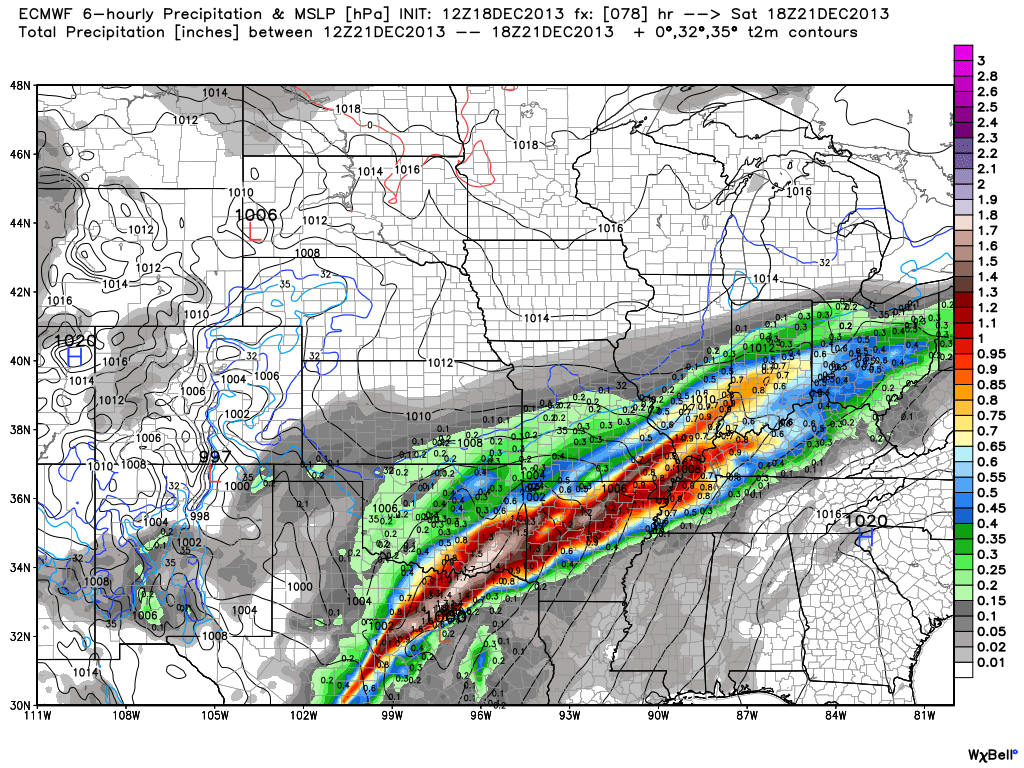
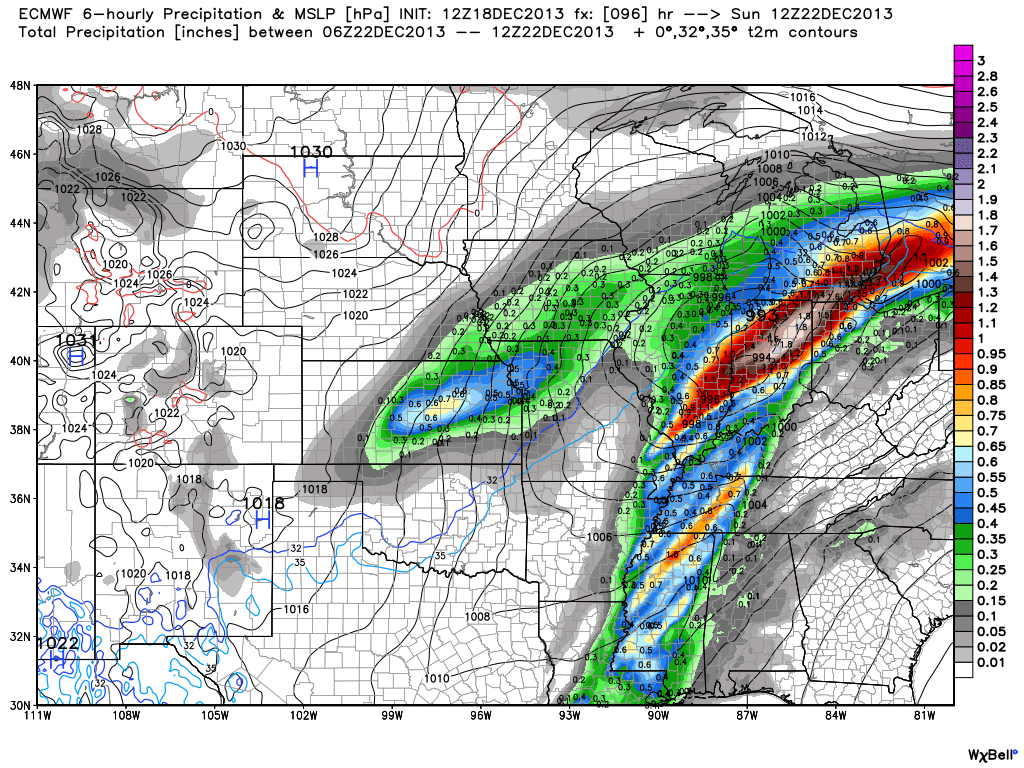
ecmwf_slp_precip_mc_14ecmwf_slp_precip_mc_17

We still have time to watch the data and monitor the track of the storm.  It’s possible the “heaviest of the heavy” axis of rain shifts somewhat in the days ahead,  but it’s also important to note that even a light to moderate rain event combined with a frozen ground and a solid snow pack still in place will lead to flooding problems here across central Indiana.  The question of whether or not we’ll deal with flooding here this weekend shouldn’t be asked, but instead the question that remains is just how severe will the flooding be?  Stay tuned and if you live or work in a flood prone area, we would recommend preparing now for flooding.

Now, as we look ahead and focus on the Christmas to New Years period our thoughts will shift from a flood threat in the near term to one that’s more wintry.  We’ll turn dramatically colder Sunday afternoon behind the big rain storm and that will set the stage for a colder-than-average run up to Christmas. In fact, latest raw numbers off some forecast model guidance has some frigid readings ahead next week (upper single digits not ruled out for lows).

The upcoming 10 days off the European forecast model charts show an interesting scenario with the coming thaw, but the key word is brief.  Note days 6-10 are back into a colder-than-normal regime.
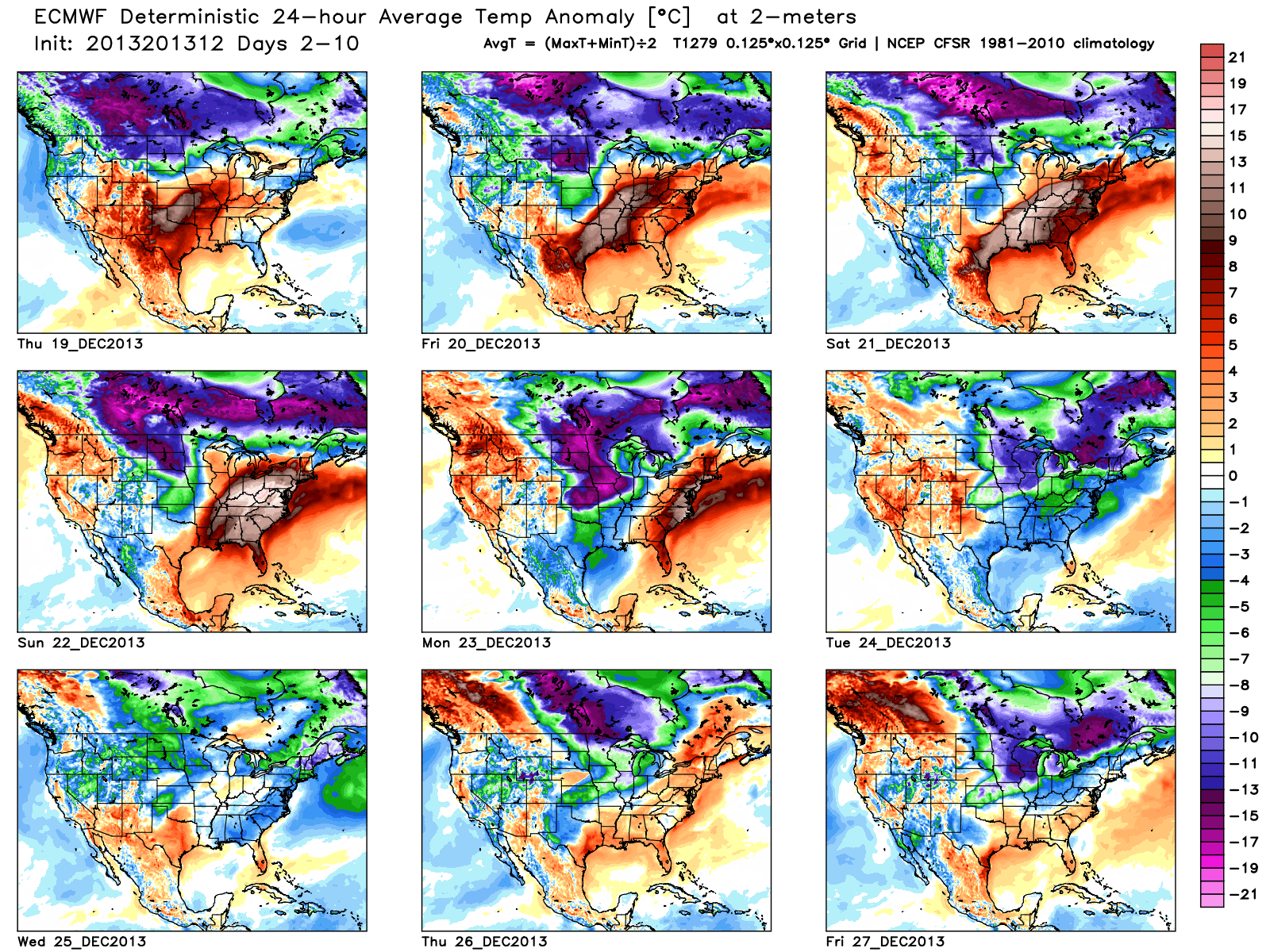
tavg_anom_ecmwf_conus_1

Additionally, we think we’ll have to deal with another storm prior to the New Year period and with the colder air back in place, there’s the threat we could have to contend with a wintry side to the next storm.  The details with storm number two will have to wait until we finish dealing with the first storm and associated serious flood threat it’s presenting.

Permanent link to this article: https://indywx.com/a-lot-of-weather-to-talk-about/

Major Storm Brewing This Weekend, But Details Are Murky…

During the late summer and early autumn months we were trying to look at the big picture and potential drivers in the overall weather pattern for the upcoming winter and openly admitted the challenges that were ahead.  Here we are now into the second half of December and a much colder and snowier-than-average month is a virtual lock at this point.  Furthermore, consider this has all taken place without the presence of a favorable NAO or PNA.  Sometimes you have to look for other drivers in a pattern- in this case, the EPO, as well as a growing early fall snow pack across the border to our north.  Additionally, we made mention of the likelihood of a southeast US ridge periodically making itself known through the winter of ’13-’14.  You can read all of our thoughts posted earlier this fall here, or by clicking the Thoughts On Winter ’13-’14 page above.

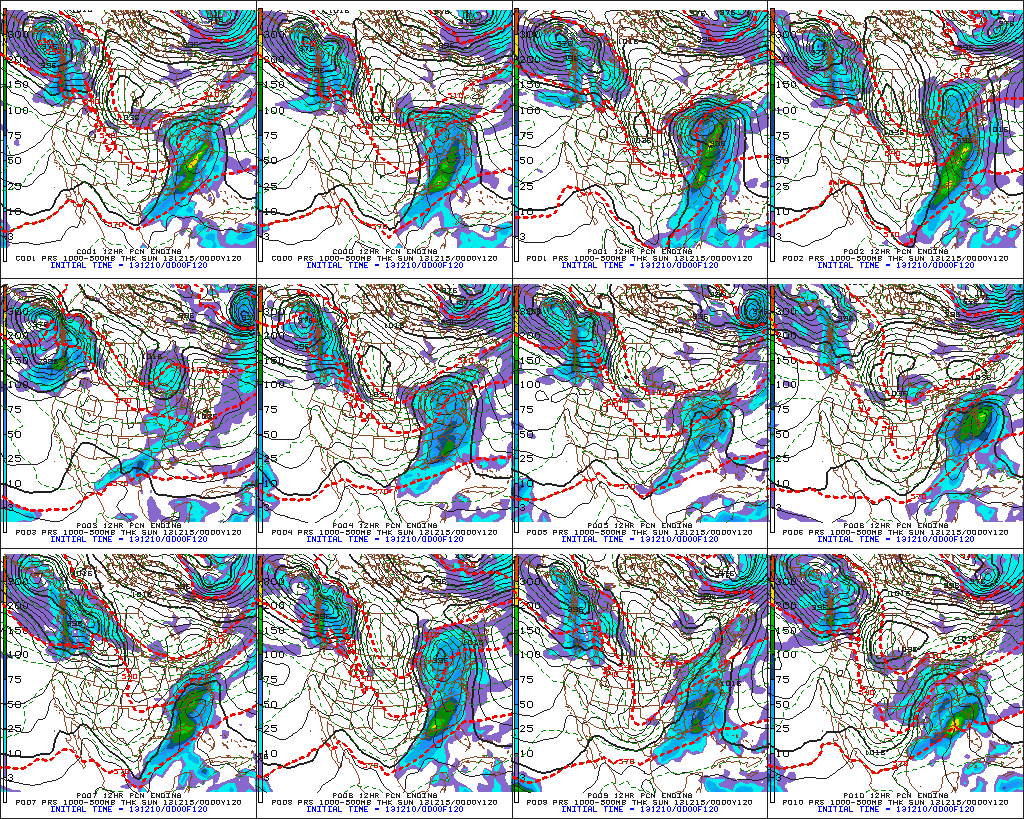
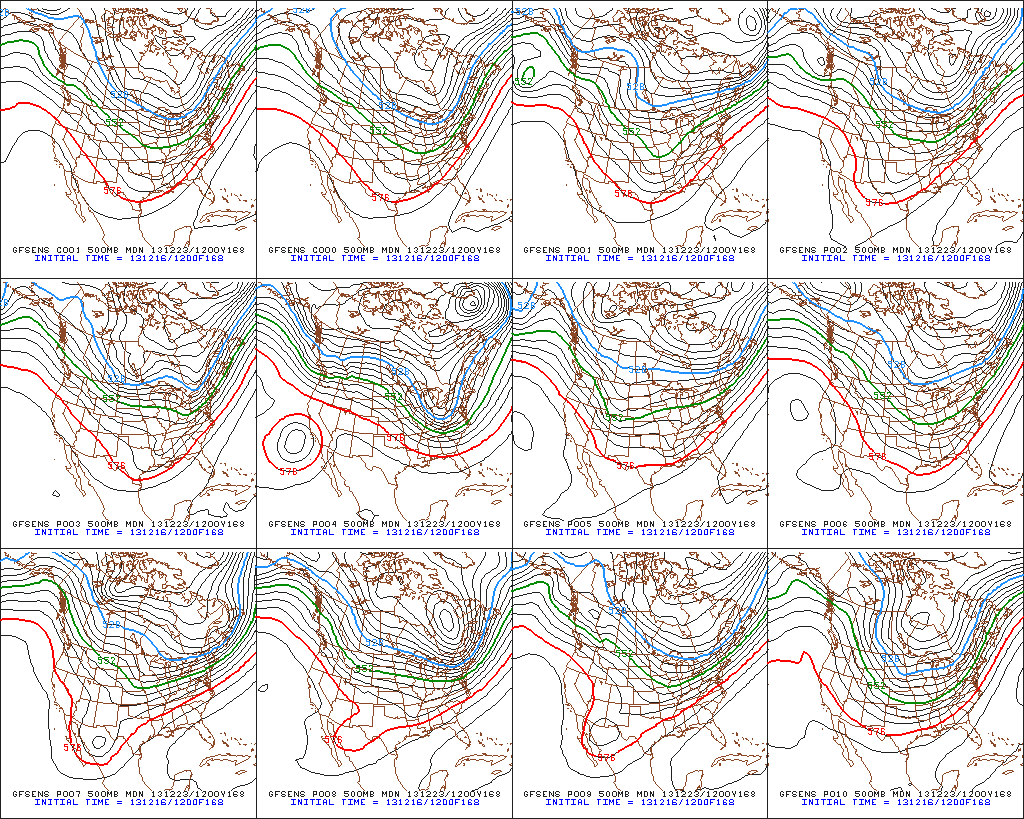
As we look ahead towards the upcoming wintry challenge, we’re confident of the overall pattern, but the sensible weather that’ll ensue is still up for great debate.  “Gut” tells me central Indiana will be looking at a rain to freezing rain scenario, but this is far from set in stone, and sometimes forecasters who go simply off their instinct can get burned.  The pattern is one that (once again) will feature a pressing arctic front against resistance from the southeast US ridge.  With this type of scenario, I would advise against looking at each and every individual operational model run, but instead invest time studying the ensembles- an average of several multiple model runs as opposed to just one operational model run.   I can guarantee a variety of wild solutions ahead in the days to come, based off the operational runs. (Heck, just the past 24 hours have been reason enough to have the dramamine on hand :-)).  That said, let’s take a look at the latest GFS and European ensembles, two models that we rely heavily on in the mid range weather pattern.

First, the GFS, valid Saturday through Monday.

f120f144f168

Now, here’s a look at the latest European ensembles (left), again valid Saturday-Monday.

Geopotential32at32500hPa_North32America_120Geopotential32at32500hPa_North32America_144 Geopotential32at32500hPa_North32America_168

So what do all of these cool maps tell us?  Simply put, that “wintry mischief” is brewing for the weekend.  That much we know, but the details have to be ironed out.  It’s likely heavy snow and a significant ice storm looms for some of the Mid West and Ohio Valley for the upcoming weekend.  Is that Indianapolis or Chicago?  Perhaps in between?  It’s too early to know.  Additionally, in the “warmer” sector, heavy rains are likely to combine with an impressive early season snow pack for some to lead to flooding concerns.

A couple of additional items to note. Many times at this stage in the game (still 5+ days out) with this type of pattern, forecast models really struggle with handling low level cold air.  Cold air is very dense and, in this type of set up, can easily drain much further east and south than forecast at this juncture.  Additionally, sometimes the modeling can put too much “umph” into the associated surface wave that moves along the arctic front resulting in a further north track than what may actually occur when the event draws closer.  Just something to keep an eye on as we draw closer…

Needless to say, it’ll be particularly important to keep a close eye on the developing weekend forecast as we move forward.  It’s likely folks in the Ohio Valley region have to deal with significant precipitation amounts in the Saturday-Monday time period, including rain, freezing rain, and snow.

Permanent link to this article: https://indywx.com/major-storm-brewing-this-weekend-but-details-are-murky/

Snowy Pattern Continues…

Considering we’re only a third of the way through December, we’re certainly running “snowier” than normal at this very early stage in the game.  As we look ahead at the upcoming 10 days, or so, we see this snowier than normal pattern continuing with multiple systems to contend with over the course of the upcoming couple weeks.  Up next will be the threat of some light snow showers and flurries with reinforcing arctic air Wednesday PM.  Nothing significant is anticipated here on Wednesday, accumulation-wise, but snow showers will blow through the area Wednesday afternoon.  The latest high-resolution NAM shows this well.

hires_ref_indy_37


Then our attention turns to a developing winter storm for the weekend. We think clouds increase Friday and snow develops Friday night into early Saturday.  Here’s a look at the latest GFS forecast model, valid Friday night.

gfs_ptype_slp_east_17


Fast forward that to Saturday morning and snow grows heavier…

gfs_ptype_slp_east_18


The GFS suggests a weak surface low tracks into eastern Ohio with backlash snow showers and embedded squalls continuing here Saturday night into Sunday.

gfs_ptype_slp_east_20


It’s important to remember that we’re still a few days out from this event and I can guarantee you things will change as we go through the course of the upcoming few days that will require us to do some adjusting to our forecast Friday-Sunday.  That said, at this early stage in the game, unlike with our last storm, I’d favor areas from IND and points north as the place where heavier snow falls this go around.

Latest GFS ensembles suggest something similar to the operational run shown above with one low tracking into the eastern Ohio Valley as another coastal low develops.

f120

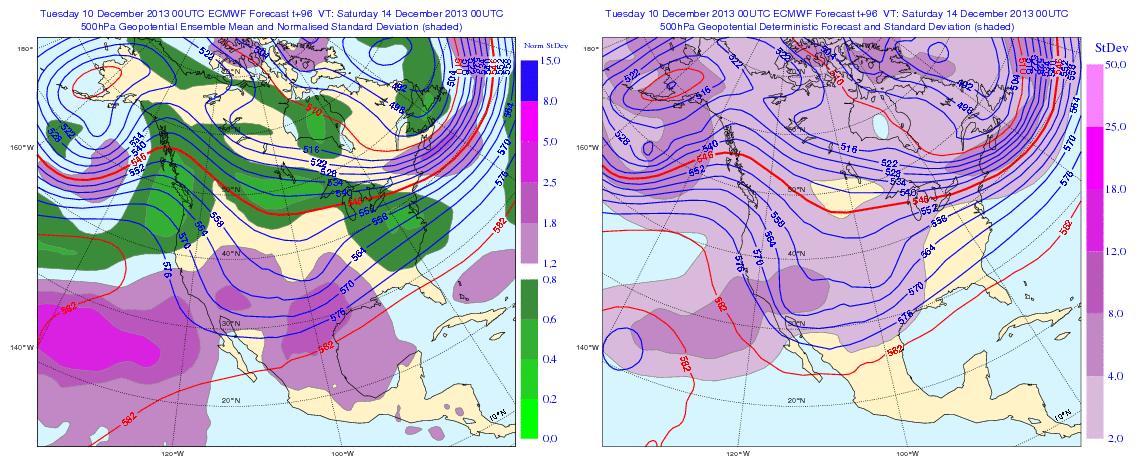
The European ensembles provide an “intriguing” look for an Ohio Valley winter weather event this weekend, as well.

Geopotential32at32500hPa_North32America_96


A couple of additional items to consider at this early juncture- this will be a fast moving winter storm so that will have an impact on snowfall accumulation.  Additionally, there’s also the chance enough warm air aloft advects (WAA or warm air advection) into the southern portions of the region to result in “mixing” issues (i.e. sleet and freezing rain).  In the primarily “snow zone” Friday night-Saturday (again, we’re currently targeting IND and points north for the snow zone) several inches of snow could accumulate.

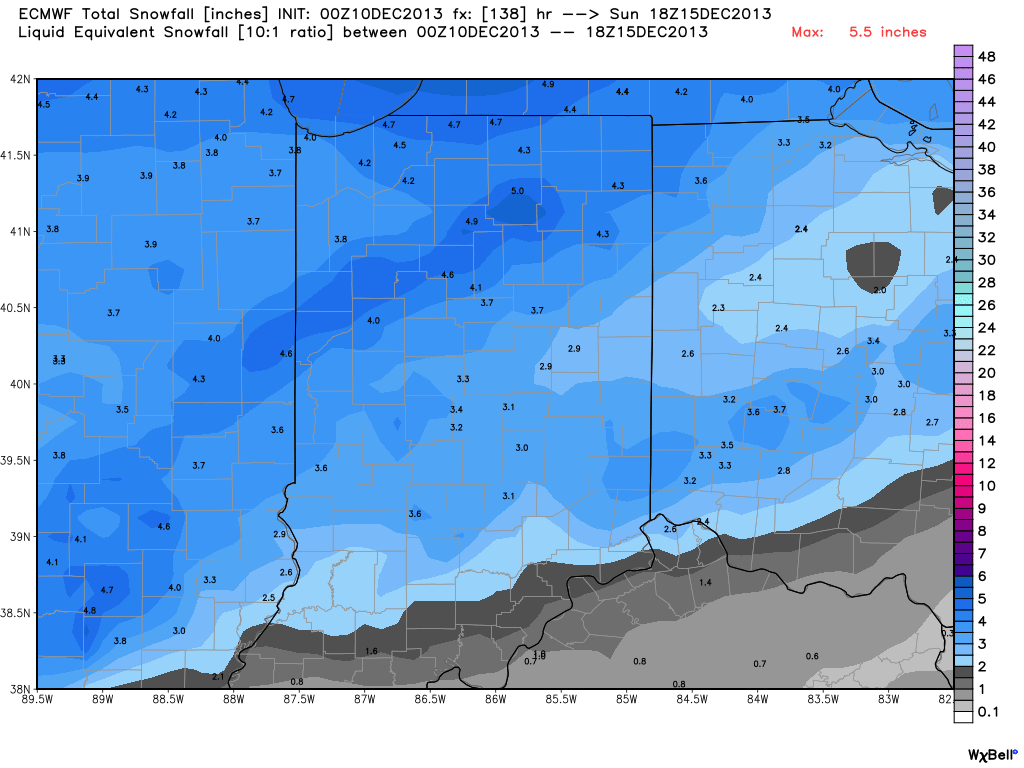
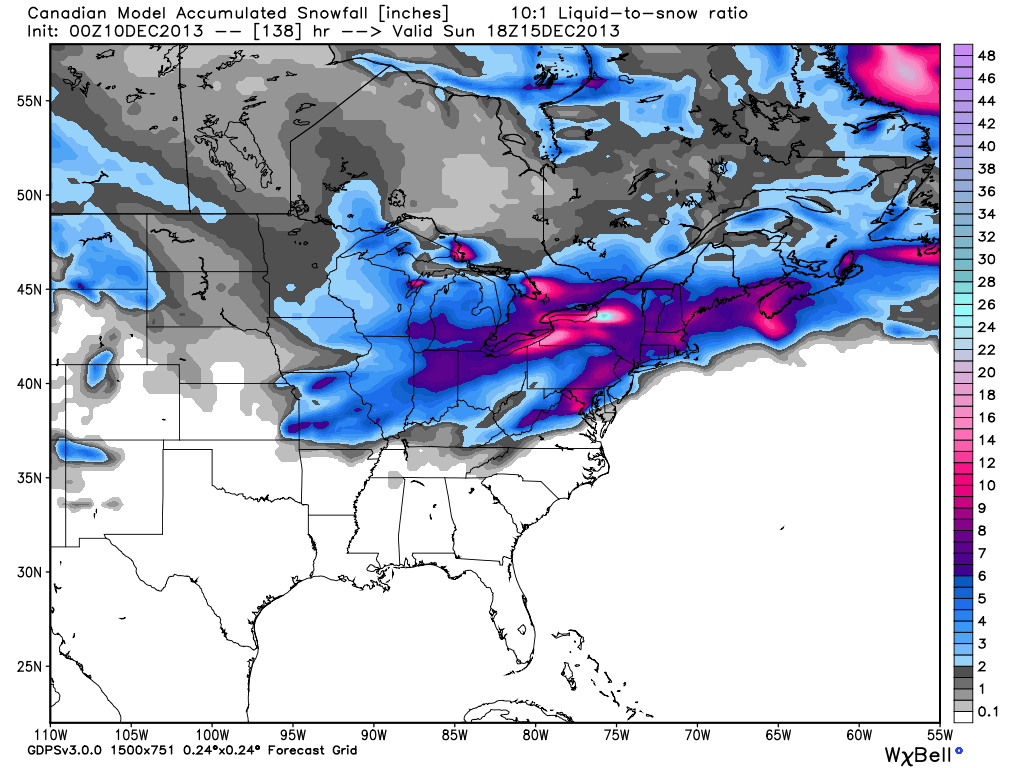
Here’s an early look at what the latest mid-range forecast models are seeing in terms of potential accumulations with this event.  Top to bottom: ECMWF, GFS, and Canadian.  Stay tuned, we’ll have another update later!  Enjoy your day!

ECMWFGFScmc_snow_acc_east_24

Permanent link to this article: https://indywx.com/snowy-pattern-continues/

Data Suggests Cold Pattern Keeps On Keepin’ On…

As we approach the all-important holiday travel season, I thought it would be nice to review what some of the data suggests in the long range sense.  While nothing is “set in stone” talking about weather 2-3 weeks out, we feel pretty confident in the overall idea of a colder than normal pattern and one that’s also potentially wintry- from a precipitation perspective.  The specifics with each storm will have to be handled as they come.

Let’s look at some of the data.  BTW, I want to give full credit to the awesome model suite that can be found at Weatherbell Analytics for some of these images.  Be sure to check them out at weather bell.com.

First, we’ll take a look at the Canadian ensembles, centered on the 8-16 day period.  Note the tongue of cold coming out of western Canada, extending southeast and encompassing the Ohio Valley region.  Folks, this is significant cold forecast off the Canadian ensembles as temperatures are suggested to average 5-7 degrees (C) below normal.

can_t2m_mean_conus_d8_16


The latest GFS ensembles also suggest widespread colder than normal temperatures over the upcoming couple weeks.  Similar to the Canadian (above), the GFS suggests temperatures average 5-7 degrees celsius below normal.

gefs_t2m_mean_noram_d0_16


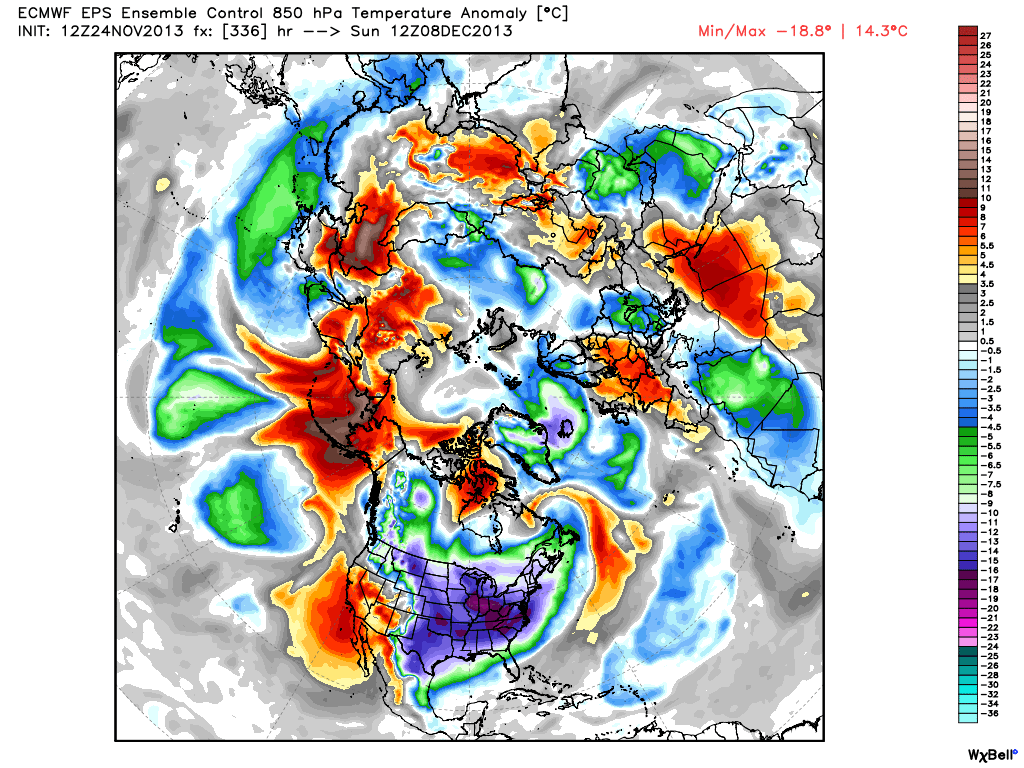
Latest European ensemble data suggests a cold look as well, but one that also may feature a day or two above normal (over the next couple weeks). The latest ensemble control run highlights the threat of some bitterly cold arctic air plunging south towards the second week of December (posted below).  We’ll continue to monitor this in the days to come.

eps_t850a_c_nh_57


Here’s a look at the latest CFSv2. While it’s in stark contrast to only a couple of weeks ago (in its December forecast), the model is now onboard with most other data in forecasting a colder than normal December for our region.

CFSv2.NaT2m.20131124.201312


It has to be pointed out that all of the cold data is forecast during a time where the three “major” teleconnections really aren’t in the most ideal spots for eastern cold.  Typically, cold lovers across the eastern United States want a negative AO and NAO with a positive PNA. The NAO and AO are forecast to be very “sporadic” over the course of the upcoming 7-10 days while the PNA is forecast to go back negative.  That said, the NAO has the biggest influence on our weather from January through March (we’ve covered this in posts in the archives).  The expansive early season snow and ice pack through western Canada is having it’s say with a couple of early season “brutal” cold shots here (it’s very rare to get this kind of cold so early in the season).  We’ll continue to monitor these teleconnections moving forward for any sort of a more defined signal that may begin to come to fruition.

Speaking of snow and ice cover; look at how much more territory across the Lower 48 is covered with snow and ice compared to this date (November 24th) last year.  Impressive, huh?

November 24, 2012 (11.8% covered in snow)

nsm_depth_2012112405_National

November 24, 2013 (37.8% covered in snow)

nsm_depth_2013112405_National

As we look closer at the near term, there’s a chance of some light snow moving in Monday evening (not a huge deal, but some light accumulations of a dusting to half an inch are possible).  Scattered snow showers will also blow into central Indiana Wednesday as a reinforcing shot of fresh arctic air blows in prior to Thanksgiving.

In the mid range, both the GFS and European ensembles (below) suggest an “intriguing” look for the first 10 days of December for the potential of a more widespread winter weather maker.  It’s far too early for details, but with arctic air being supplied into a pattern that looks to have a southern branch beginning to flex it’s muscle, we’ll have to remain on our toes as we go into December…  Here’s wishing you a very happy and healthy Thanksgiving, complete with safe travels!

Geopotential32at32500hPa_North32America_240gefs_z500anom_nh_65

Permanent link to this article: https://indywx.com/data-suggests-cold-pattern-keeps-on-keepin-on/

A Closer Look At Thanksgiving Week

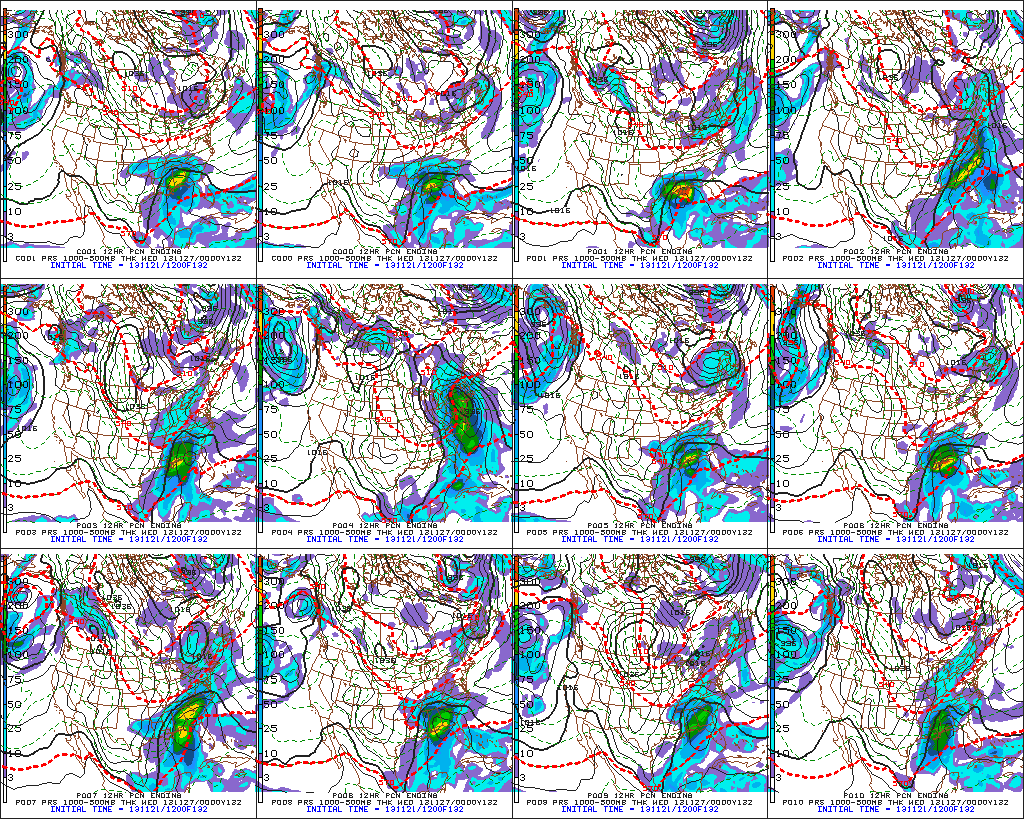
Today’s model data continues the theme of a southern and eastern storm for the days surrounding Thanksgiving.  We’ll continue to monitor for any potential shift northwest, but as of now, the trend remains for a “suppressed” storm track.  Here’s a look at the individual GFS ensemble members, off today’s 12z run.  Taken at face value, 3 out of 10 members show some light snow in the air.

f132

For now, the big story still appears to be the unseasonably cold air around for Thanksgiving.  The ECMWF, Canadian, and American models (GFS and NAM) continue to hammer home the idea of a frigid Thanksgiving ahead (relative to the time of year, of course).  I’m not convinced we won’t have to deal with some light snow next week at some point, but for now, the bigger story still appears to be  impressive early season cold, and this cold pattern isn’t going away anytime soon.

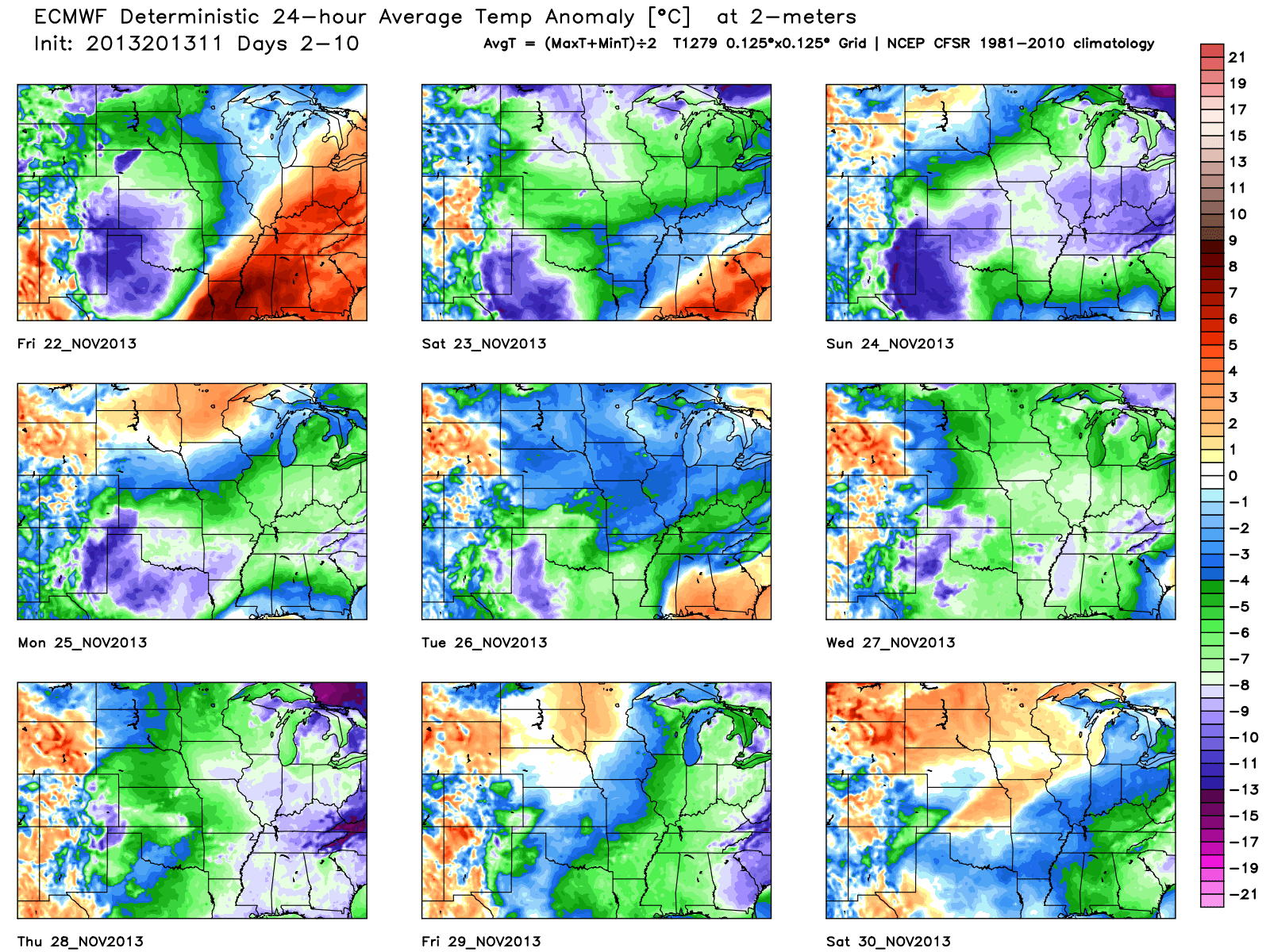
The latest European forecast data illustrates this well.  Note each and every day is well below normal, aside from tomorrow (cold air pushes in tomorrow PM).  This is a snap shot of the average temperature (in degrees C) over the upcoming 10 day period.  The blues, greens, and purples showcase the cold, relative to average.

tavg_anom_ecmwf_mc_1


Permanent link to this article: https://indywx.com/a-closer-look-at-thanksgiving-week/