Facts Are Facts…

I’m hearing rumblings out there that you can’t get sustained cold across Indiana without a negative Arctic Oscillation (AO) and/ or negative North Atlantic Oscillation (NAO).  I would ask those with that belief to please explain the following:

January temperature anomalies month-to-date show widespread cold (even accounting for the January thaw the past week).

ncep_cfsr_noram_t2m_anom


The first two weeks of the month were downright frigid and this was in the face of an AO that was not just positive, but strongly positive.

AO

To take this a step farther, the recent relative warmth has come with a negative AO.

Bottom line is that a ton of drivers are trying to take the wheel this winter.  Admittedly, that makes things incredibly difficult for forecasting- short-term or longer range.  That said, coming out with a “blanket statement” that you can’t have sustained cold without a negative AO or NAO is a flat-out lie and we wanted to address it.  Teleconnections can help many times with coming weather patterns, but not always.  This winter is a prime example of that.

Quick note on the clipper system- all forecast models today have taken the primary impacts (at least from a snow standpoint) north of the immediate region (central Indiana). Heaviest snows are favored across the Great Lakes, extending down into northern IN. We’ll continue to keep a close eye on things…

Fast-Moving Weak Weather Systems…

Screen Shot 2015-01-19 at 8.27.43 AM

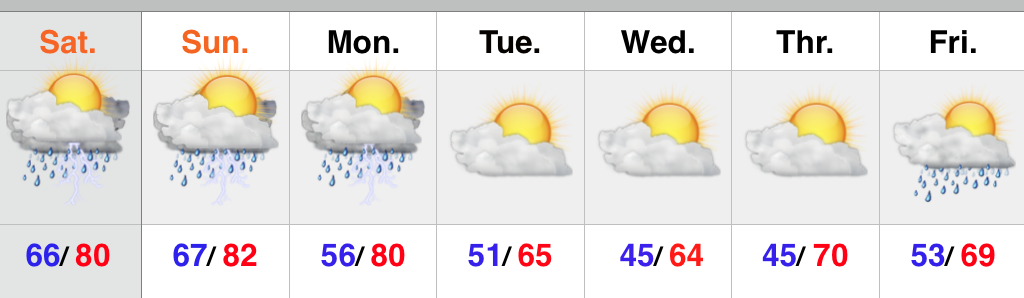
Challenging Northwest Flow…A series of fairly weak weather systems will scoot through the region through the first half of the week.  Each disturbance will be capable of depositing a quick round of light precipitation.  Timing will be the biggest issue at hand with the first couple weak disturbances.  We’ll forecast light rain (perhaps a wet snow flake or two) tonight into the wee morning hours Tuesday and again Tuesday night into Wednesday morning.

A drier stretch of weather will arrive for the second half of the work week and early portions of the weekend.  We target Sunday evening as the next opportunity for accumulating snow followed by a push of colder air.  As of now, week 2 is looking unseasonably cold after seasonable to above average temperatures this week.

Upcoming 7-Day Precipitation Forecast:

  • 7-Day Rainfall Forecast: 0.30″
  • 7-Day Snowfall Forecast: 2″ – 3″

A Word On The Longer Range; Steady As She Goes…

We wanted to touch briefly on the longer range weather pattern as we’ve been answering questions this weekend out there concerning what lies ahead. Ultimately, the good Lord above is the only one who knows tomorrow and this idea we have very well may be the wrong one. However; we still see a lot of winter in this weather pattern. The combination of below average snowfall to date, combined with milder air the past 24 hours has led some winter lovers into a panic. Despite the past 24 hours, let’s remember where we are for the month of January through the first half:

image

Now let’s compare this to the infamous January 2014:

image

So far, this January the cold is more widespread across the nation. Additionally, through the first half of January, IND is actually running colder than last January. Many remember the brutal cold following the major winter storm early last January. Let’s also remember that a few days after that snow and cold we were dealing with much milder air and rain- a bonafide January thaw.

That brings us back to the present and our current January thaw. Looking back through the record books indicate even the coldest Januarys on record have “thaws.” What’s perhaps more impressive is that the end of this year’s thaw appears to be seen really before it even begins.

There are so many different drivers trying to take the wheel this winter it, admittedly, makes for an incredibly challenging time of things forecasting. That said, should we see the “stars align” (negative AO, negative NAO, positive PNA) in the coming weeks, this is the type scenario that could carry winter deep into spring.

In the shorter term, as of now we see no reason to abandon the idea the cold reloads to close January and open February. It’s possible that some weather outlets lean heavily on particular model runs and base their mid to long range forecast accordingly. While we agree you have to supplement some of that data into your mid and long range forecast, this is the type pattern than can make for risky business putting all the eggs in one basket.  (We also suggest any outlets leaning solely on operational and ensemble output are in need for a serious dose of dramamine). Instead, we prefer a blend of the above with the foundation being a combination of a nearly ideal SST profile for wintry times continuing and big-hitter analogs. It must also be noted that we have to keep the current AO/ PNA state in the back of our mind.

Speaking of those teleconnections… The current AO and PNA leave a lot to be desired for winter lovers in the longer range:

image image

That said, it should be noted the first two weeks of January cold was in the face of teleconnections that screamed of a warm pattern and a MJO phase that was also mild.

Perhaps the bigger driver here is the surface temperature profile in the PAC and ATL. Also note the modoki El Niño.

IMG_2167.PNG

That warmer water sitting across the northeast Pacific Ocean promotes ridging into the PAC NW and AK.  In return the upper level winds tap available arctic air and send it southeast (see the first two weeks of January).

In the mid range, ensemble data is bullish on this aforementioned pattern returning after the very brief January thaw.

1

2

The sensible weather that should result the upcoming 10-12 days?  An active pattern and one that’s very challenging with that northwest flow (we’ll be on clipper watch), biased colder than average.  In fact, the GFS ensembles aren’t too shy about eastern cold week 2.

gefs_t2m_mean_noram_d8_16

Let’s watch things unfold in the coming couple of weeks.  Make it a great day and GO COLTS!